Building off work from prior years, Sen. Fillmore said they want to turn local government reserves into a revolving loan fund for use by cities and builders.
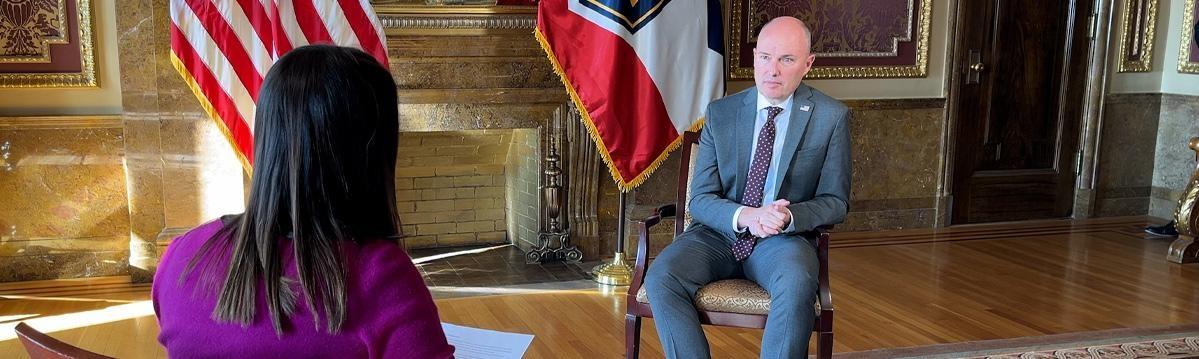
In an interview with PBS Utah, Governor Cox echoed the focus on funding for infrastructure.
“We have tens of thousands—if not more—lots that are permitted, but they're not being built on because there's no infrastructure,” said Governor Cox, during a one-on-one interview with PBS Utah. “If we can get funding for infrastructure investment in these areas, we can unlock those lots in in powerful ways.”
A few bills are already creating tension on Capitol Hill, with the legislature and courts at odds over proposed changes to the judiciary.
The bills, which have already been introduced, center around judges keeping their seats, and increasing the number of Supreme Court and appellate judges.
“There's been a clear pattern of abuse, lack of accountability, some procedural issues,” said Representative Casey Snider (R-Paradise), to reporters on opening day. “I don't think any of us want to be in this difficult position of conflict with our judicial branch, but we can't ignore it anymore because the people aren't ignoring, and that’s what we’re hearing about from our constituents.”
The bills come after a series of contentious court rulings on congressional redistricting that some lawmakers have publicly condemned.
Rep. Snider said things have “come to a head” from the last several years, adding that, “It’s not about any one particular decision.”
“There have been several poor decisions, several clear, unfair situations where justice has clearly not been served, where the court has protected its own against the demands of justice,” Rep. Snider said. “And so, we're in a position where we have to react moving forward, unfortunately.”
During a speech to the House and Senate later that day, Chief Justice Matthew Durrant talked quite a bit about that tension and asked the legislature to pause on adding more seats to the Supreme Court.
“No, our institutions are not perfect, and so yes, they can be improved,” Justice Durrant said. “But they are not the cesspools of corruption and self-interest that some would have you believe.”
Energy is once again emerging as a main legislative topic, with Gov. Cox saying they want to work on critical minerals.
“You'll see a couple bills focused on unlocking critical minerals in the state, trying to make permitting much easier for companies that are coming in and accessing those critical minerals, so we're not relying on China and other global adversaries,” Gov. Cox said. “We can do that work here, and that will make us safer and make energy cheaper for everyone.”
During a press session with media members, Senate President Stuart Adams (R-Layton) said there “couldn’t be anything more exciting than that, in my mind” when responding to a question about potentially bringing a national critical minerals lab to Utah and unlocking rare earth minerals on the west side of Utah Lake.
“We need to make sure that there is a mechanism so they can be mined quickly and efficiently. That needs to happen,” said Sen. Adams said. “My hope is that this spring they'll be actually processing those critical minerals.”
Gov. Cox said his number one priority heading into session: Education investments. Funding could be a challenge, as the legislature is expected to operate on leaner numbers than previous years.
Despite not having “big budgets like we’ve had in the past,” Gov. Cox said he expects it to “be a good funding year” for education.
“Literacy to me is the most important piece of that. It's the foundation for everything. If you can't read at grade level, by third grade, the odds of you succeeding in life go down precipitously,” he said. “We want to make sure that that doesn't happen for any of our kids.”
Stay up-to-date as PBS Utah’s Utah Insight continues legislative coverage throughout the session on YouTube, Instagram, and Facebook.
.jpg)