“That's where our grandparents had made our home for us,” Badback said. “That's what we want to continue… raising our kids or grandkids, because that's where our grandparents had raised us.”
White Mesa sits within the Ute Mountain Ute Tribal Reservation in San Juan County, near Bears Ears National Monument.
It also sits five miles down the highway from the White Mesa Uranium Mill, in the heart of Utah’s uranium mine belt. The mill was originally built in 1980 to process uranium ore from nearby mines for use in weapons and nuclear fuel.
“We used to be a county that was full of drilling and mining. I mean, that sustained this county.” said San Juan County Commissioner Lori Maughan, who has seen the boom and bust of the area’s uranium mining industry.
“I also remember growing up, that mill has open and shut and open and shut many times, changed a lot of hands,” she said, of the mill’s operations.
Maughan explained that since current owner Colorado-based Energy Fuels took control of the mill in 2012, business seemed to stabilize.
“It's been steady. It’s been very steady,” Maughan said. “It’s kind of been running for quite a few years.”
In the absence of an abundance of uranium ore, the mill also takes in and processes other kinds of radioactive material called alternate feeds from various locations.
Utah Mining Association President Brian Somers explains alternate feeds are, “when you have contaminated soils from industrial sites and other things that they could process [at the mill].”
Somers doesn’t work for Energy Fuels or the mill, but he’s very familiar with its history and current operations.
Sitting in the Utah Mining Association offices in the historic downtown Salt Lake City Kearns building, Somers explained how recently, the mill expanded to a one-of-a-kind operation for the US: Producing rare earth elements, used to make high-tech devices.
“Rare earths are in all kinds of things that you use every single day,” Somers said. “Everything from wind turbines to electric cars, to the little things that make your cell phone vibrate.”
Concerns for public health
Members of the Ute Mountain Ute Tribe and environmental groups aren’t sold on Energy Fuels’ business model.
“It's a radioactive waste disposal facility more than a milling facility,” said Scott Clow, environmental programs director for the Ute Mountain Ute Tribe. He is not a member of the Tribe but works in its Environmental Programs Department at the Tribe’s headquarters in Towaoc, Colorado. Clow’s job is to ensure what’s happening on site isn’t making its way into White Mesa.
“The overlying concern is public health,” Clow said. “The public water supply in White Mesa is a groundwater supply… So, there's also concern that it's impacted by the mill.”
“We don't want our water to be contaminated,” Badback expressed. She and her mother worry about what they drink, and what they breathe.
“When you pass the Energy Fuels… you could really smell it real bad,” Whiskers said. “When the wind blows too, you know, you could smell it when the dust and everything comes through this way.”
On an October morning, Whiskers stood in front of a crowd in the White Mesa Community Center parking lot to talk about those concerns.
“I get wary about my grandchildren, my children,” Whiskers said, speaking on the microphone.
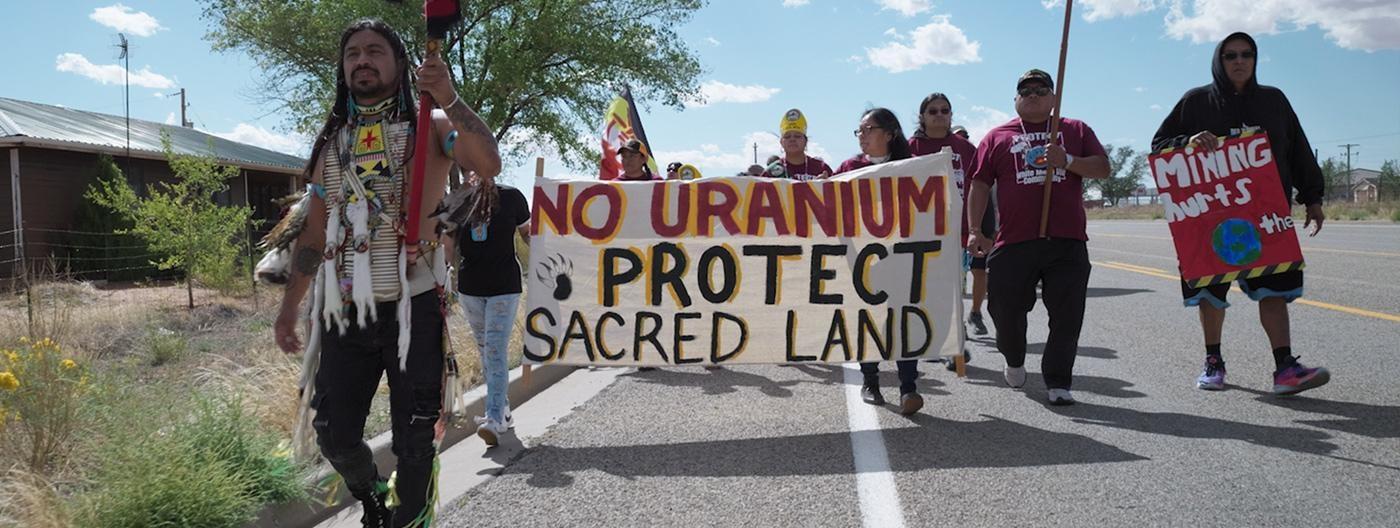
Badback runs White Mesa Concerned Community, and organizes the annual White Mesa Ute Community Spiritual Walk and Protest against the mill, drawing in people from all over the region. In addition to expressing concerns about the mill facility, Whiskers brought up trucks hauling ore through town using the same roads as their school buses.
“When they’re on the bus in the morning, here come the trucks—two or three trucks—they go by, they zoom by really fast,” Whiskers recounted.
The district Maughan represents on the San Juan County Commission doesn’t directly cover White Mesa and the mill, but she still hears the concerns.
“It scares people. I mean, are we going to have a spill? Are we going to have a wreck?” Maughan said, of what people often worry about.
She explained the concerns largely stem from past lack of regulation and standards in the uranium mining and milling industry, when “people didn't know what [uranium] did.”
“Everyone mined… and then all of a sudden they're realizing, okay, this causes cancer,” Maughan said.
For Whiskers, it’s personal.
“I had a brother; he was my oldest brother. When this White Mesa Mill just opened, that’s where he used to work,” she explained. “He got sick… he passed away.”
Tight regulations and frequent testing
The mill is regulated by the Utah Department of Environmental Quality's Division of Waste Management and Radiation Control, or DWMRC, meaning the state manages the regulations and standards that the mill must abide by. That includes monitoring both the air and groundwater for any potential contamination.
DWMRC’s uranium recovery section manager Adam Wingate explained that he focuses on both employee and environmental safety, through conducting site visits and inspections, overseeing sample collection and analyzing data, and reviewing reports and permit applications submitted by Energy Fuels.
Sitting at his computer in his office in Salt Lake City, Wingate pointed to a map on his screen with more than two dozen points on it.
“These red dots make up the locations of all of our various monitoring wells. There are actually three well networks on the facility,” Wingate explained.
He described how groundwater samples regularly collected from the 30 wells in and around the mill are tested for a long list of metals, elements, and chemical compounds—especially around the large, lined tailings impoundment ponds.
“The major concern then would be if that had some kind of leak or failure of the liner system, these very acidic, very high metal concentration liquids and sands could penetrate into the groundwater and then contaminate the groundwater,” Wingate explained. “And that is why we collect 900 points of monitoring, every sampling period.”
He talked about how the DWMRC expanded testing over the years and found contamination in the past. The first was discovered about 25 years ago, the second a decade later.
“There was a legacy contamination from an old laboratory that was on site where chloroform did enter the groundwater,” he noted. “One of the main reasons that we found the chloroform plume was we monitored for a wider range of constituents, and a similar thing happened about ten years later for the nitrate plume.”
The source of the nitrate plume, he said, was never officially identified.
He said the DWMRC has a corrective action plan in place for both plumes, with a pumping program and monitoring networks. As he closely follows the cleanup, Wingate said the data doesn’t show contamination migrating from the mill site, from either of the plumes or from any other mill-related activities.
“We don't have any evidence that either of these plumes have any impact on that lower drinking water supply aquifer. It’s all isolated in this upper [perched] aquifer,” Wingate explained. “But that doesn't mean it's not a problem, right? Like the responsibility is to protect the air, land, and water.”
‘It’ll be here forever’
Standing inside the White Mesa Community Center gym in front of a group of people, Clow pointed to an aerial image of the mill projected onto the wall during a presentation.
As part of the annual White Mesa Ute Community Spiritual Walk and Protest, a mini conference in the gym features speaker sessions on uranium, including by Clow.
He talked about the mill’s history up to present day, and its current operations of taking in alternate feeds.
“The most far away place, which was authorized in 2021 by a license amendment issued by the State of Utah, authorized [the mill] to receive materials from Estonia,” Clow explained to the crowd.
He’s constantly following the data and DWMRC tests himself, and said the state has raised the bar on monitoring.
“We appreciate what the State of Utah has done in that regard, in getting real on the quality of data that’s collected,” Clow said. However, he said he doesn’t agree with some of the methodology behind the regulatory system.
“There are increasing concentrations of uranium in some of those [wells] that are much higher than what we observe in all of these other wells around the mesa,” Clow explained. “So, something's going on there with uranium and selenium really spiking in that hot spot.”
The Ute Mountain Ute Tribe runs its own testing network and collects its own data from both an air monitor in White Mesa, and groundwater wells near the mill.
What they’ve found?
“We have those data, and we're on top of that. So yeah, there's nothing alarming there,” Clow said, of the samples and data collected from the tribal-run wells.
He also explained that despite the smell people like Whiskers have noticed coming from the mill, the air quality tests have not picked up anything hazardous to public health.
While the tests don’t indicate any community contamination or public health hazards, Clow explained that ultimately, it's not just about the measurements coming from the wells. For members of the Tribe, he described how it's also about the context of culture and generations of history tied to the land.
“This whole landscape is very important to the people here. And to have thousands of acre feet of toxic waste and this facility now being an international dumping ground, is profoundly disturbing to people here,” Clow said.
He’s concerned about a potential expansion.
“The direction of expansion is south towards the community. So, each expansion of the disposal impoundments will get that much closer,” Clow said. “Big picture for the Tribe, it’s all spelled out in there, like this stuff is going to be here forever.”
A ‘critical hub’ for the entire nation
Energy Fuels declined to interview, but they’ve stated in multiple recent press releases that the company has ramped up production. Many people see that as a good thing, like Brian Somers over at the Utah Mining Association.
“That’s a huge asset for us to have that mill here in the state,” he said. Somers described how it’s the only conventional uranium mill left standing in the country because the US switched to mainly importing uranium from overseas to cut costs.
According to the US Energy Information Association, the country purchases uranium from Canada, Kazakhstan, Australia, Uzbekistan, Namibia, and Russia.
“We've got very stringent laws and regulations around mining, and around mineral processing here in this country,” Somers explained. “You shift production to countries that don't have the same environmental and labor standards, and you can do it more cheaply, but you're also not doing it responsibly.”
Somers described how the US wants to bring local uranium production back, citing global events like the invasion of Ukraine, and the push for nuclear power and US energy independence.
“The nuclear industry provides about 20% of the electricity that we use in the US,” he said. “The energy demand is increasing substantially, and you have to be able to have on-demand power all the time.”
Utah state lawmakers and Governor Spencer Cox are also enthusiastic about nuclear energy and the rare earth elements that Energy Fuels recently began producing that fuel our modern technology.
Right now, most of the world’s rare earth element supply is mined and processed in China.
In an interview with PBS Utah, Governor Cox said legislators are focused on unlocking critical minerals that are “important to the energy process.”
He said they were, “trying to make permitting much easier for companies that are coming in and accessing those critical minerals, so we’re not relying on China and other global adversaries.”
Recent legislation aims to fast-track critical mineral production in Utah.
“We can do that work here, and that will make us safer and make energy cheaper for everyone,” Gov. Cox said.
The resurgence of uranium paired with the emergence of rare earth elements is putting the White Mesa Mill in the national spotlight.
“I think that Utah really especially has an opportunity to be an energy and critical minerals hub for the entire country,” Somers expressed.
“Think about where those minerals come from that you’re using in your smartphones, and your cars, and your household,” Somers said. “And also, the energy that you use… where does that come from and how reliant are you upon that?”
Both Somers and Maughan indicated that today’s strict regulations mean the industry is safer than ever before.
“When I hear people say it's a toxic waste dump, I don't agree with that because of the things that they are required to do,” Maughan said, of the mill.
“We need to realize that they have to meet some high standards,” she expressed. “This is not just something that they can, you know, run amok and hope for the best.”
Maughan talked about seeing quite a bit of local support for the mill, including from some tribal members.
“A lot of those people that live there, actually work and have jobs at the mill,” she said.
According to state data, Energy Fuels is one of the larger private employers in San Juan County. U.S. Bureau of Economic Analysis data shows San Juan is historically the poorest county in Utah, consistently drawing in the state’s lowest per capita income nearly every year over the past five decades.
With that in mind, Maughan sees the dozens of jobs provided at the mill as an asset to the local economy.
“It’s really difficult to have jobs, but the mill… they pay well,” Maughan said. “You want good paying jobs.” From her understanding, the mill pays a competitive salary and Maughan said the county needs good paying jobs.
“We've got to look for ways we can survive down here and make it affordable,” she said. “And also jobs, create jobs, but also opportunities for growth.”
Finding a way forward
Badback wondered what an expansion would mean for her community and expressed concern that it could negatively impact White Mesa.
“If the mill expands any bigger… this might not even be White Mesa [anymore]. It might be, you know, empty,” Badback said, getting choked up as she spoke. “I don’t want our community to be destroyed.”
At the White Mesa Community Center, the spiritual walk group, led by Badback and Whiskers, took off from the parking lot and marched five miles up the highway, from town to the mill.
The dozens protesting, including three Ute Mountain Ute Tribal Councilmembers, demanded the mill be shut down.
“This waste is coming from all the way around the world,” said Ute Mountain Ute Tribal Councilmember Conrad Jacket.
“They should move this mill. There [are] other places they can put it at,” he said. “If it’s so clean, if it's not dangerous, then put in front of the White House and prove everybody wrong. We don't want it.”
Standing outside of the White Mesa Uranium Mill, the group held flags and chanted, “Protect Mother Earth!”
Speakers then took the microphone, including Whiskers and Badback, raising concerns over land, water, and the wellbeing of the community.
“I wish they could clean up this place up. So, we can live good, we’ll have good water,” Whiskers said to the crowd.
She doesn’t want anyone else getting sick, like what she said happened to her brother. “We care for our people no matter what. We still care for them, and the kids, our grandkids,” Whiskers said.
Clow said the Tribe is embarking on an epidemiological study to understand the full picture of the community’s health, and what could be impacting it.
“The best-case scenario is if there is no causation, and we can identify other things that are impacting people's health,” Clow said. He’ll continue stay on top of water and air reports for any sign of alarm, saying, “We're just going to keep fighting the good fight.”
Maughan sees a way forward through open communication and working together.
“The hard part is when we come in and one is just on one side of the fence, and one is on the other and not willing to budge for anything,” she said. “And that's when we make zero progress.”
As a county commissioner, Maughan described how she’ll continue working to balance community concern, with opportunity and growth.
“The main key is to be very transparent in everything we're looking at and everything we're trying to do and making that connection with our citizens… making sure their voices are heard,” she said, adding, “You can’t please everyone, but you can do the best that you can.”
Badback indicated that she will continue to advocate for Tribal voices and the future of the community she cares deeply about.
“Yes, I want this community to be safe because, you know, this is home,” she said, wiping away tears.
“Just keep fighting, no matter what,” Badback expressed. “I mean, it gets hard, but we still got to stand for what we think is right for our community.”
.jpg)