Filer image

What a Drought Emergency Means for Utahns, the Ag Industry, and a Proposed Data Center

Email share

After the warmest winter on record, Utah is facing severe to extreme drought statewide, prompting a State of Emergency with a message for Utahns to act. Governor Spencer Cox also addressed concerns about the ag industry and a proposed data center in relation to the state’s current drought.

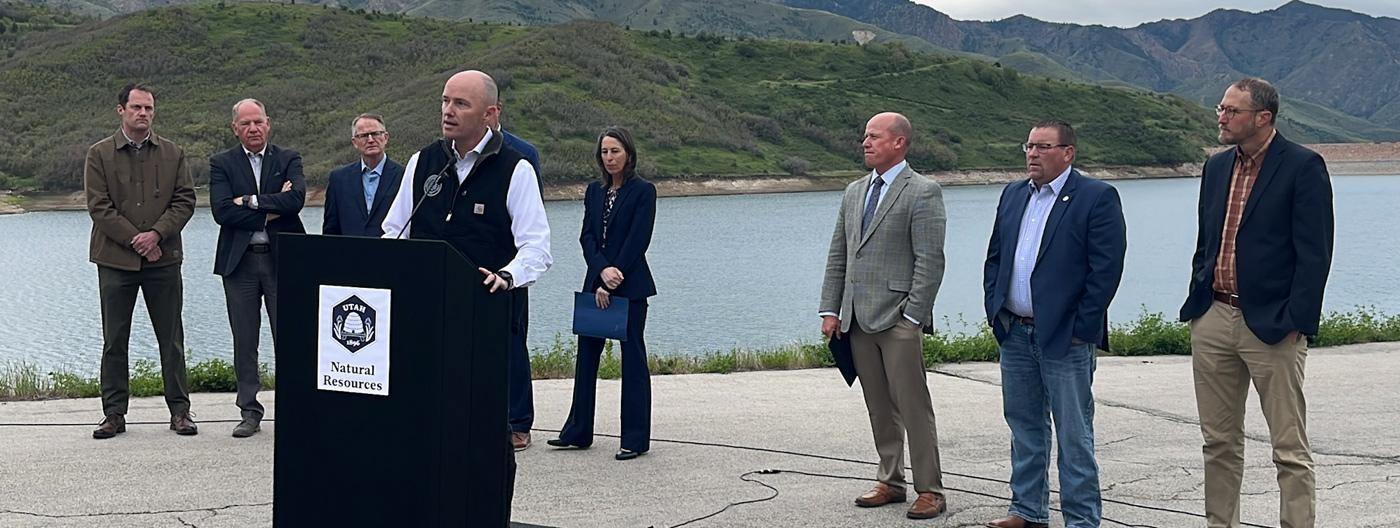
Standing near the boat ramp for Little Dell Reservoir in late May, Utah Governor Spencer Cox declared a State of Emergency through an Executive Order,  signaling the state’s dire drought situation.

He pointed to the warmest winter on record, the record-low ‘no-pack’ snowpack, and reservoirs already being in “rough shape.”

“What you see in our reservoirs today is all we have. There's no extra runoff,” Gov. Cox warned. “We can't bank on what Mother Nature might deliver next winter.”

“Precipitation isn't promised,” he said. “And conservation is a choice that we can all make and must make at this time.”

The governor, alongside state agencies like the Department of Natural Resources (DNR), urged all Utahns to act now to conserve water.

“The water in our reservoirs is like a bank account. It only lasts so long,” explained DNR Commissioner Joel Ferry.

His biggest recommendation? Cut back on lawn watering.

“Look at your look at your sprinkler systems. Are they running efficiently? Do you have leaks? Can you change your timer?” Ferry suggested. “Does your grass really need to be watered?”

Other recommendations shared by Gov. Cox and DNR:

  • Fix leaks inside and outside.
  • Run full loads (dishwashers and washing machines).
  • Turn off the water while brushing teeth, shaving, soaping up, doing dishes or rinsing vegetables.
  • Reduce showers by at least one minute.
  • For customized watering recommendations, check the Weekly Lawn Watering Guide.
  • Visit SlowTheFlow.org for additional water-saving tips and rebates for water-smart landscaping and smart irrigation controllers.
     

Gov. Cox addressed concerns during the press conference at Little Dell Reservoir, including claims that members of the public don’t believe the ag industry is conserving enough—which he said was, “a lie, and it’s wrong.”

WATCH: Drought Emergency Declared in Utah | Utah Insight | May 2026

“Farmers conserve more than any… anybody in this state,” the fired-up governor asserted. “That's where the biggest cutbacks will always be, always have been.”

Ferry explained the agriculture industry, which uses the most water in the state, has taken steps to become more drought resilient through a statewide agriculture water optimization program.

“It's piping and lining canals, it's switching out sprinkler heads to more water efficient [ones],it's putting meters and timers and measuring devices on systems, to help the ag community be more efficient in how they use the water,” Ferry said.

He added that the ag industry will still be the most impacted by drought.

“Every agriculture system is taking reductions,” Ferry said. “In fact, some systems are only getting fifteen, twenty, twenty-five percent delivery of water this year just because there's no water available.”

During the press conference, Governor Cox also refuted concerns about projected water use by a proposed large-scale data center in Box Elder County, saying water is not an issue people should be concerned about with that project.

“This data center is going to use less water than the current water use,” he said. “So, this will actually return water to the [Great Salt] Lake.”

Gov. Cox explained his main reasons for the State of emergency: Unlock emergency funding and spread awareness across the state.

“We're prepared for it, we really are,” Gov. Cox said, adding, “Everybody has to do their part.”